

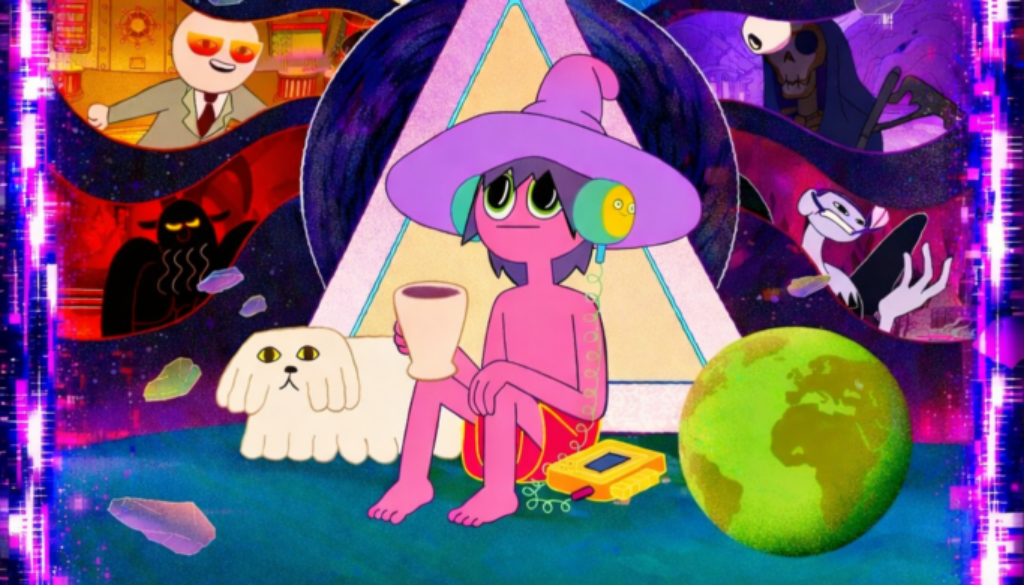
The Midnight Gospel is a Netflix adult animated series that turns real podcast conversations into surreal sci fi episodes. Created by Pendleton Ward and Duncan Trussell, it follows Clancy Gilroy, a “spacecaster” who uses a glitchy multiverse simulator to visit collapsing worlds and record interviews for his show. The hook is simple on paper but unusual in practice: the dialogue comes from Trussell’s actual long form interviews, while the animation builds a parallel adventure around the audio, matching the topics with chaos, monsters, and absurd set pieces that keep escalating. Across eight episodes released in 2020, each world feels like its own genre experiment, from post apocalyptic farce to cosmic horror to bright cartoon satire, but the series is less interested in worldbuilding as lore than in worldbuilding as pressure. The plot is always “something is ending,” and the conversations are always “what can a person do with that fact.” Clancy is not a hero with a destiny. He is a curious, distracted host who keeps wandering into danger because he is chasing content, comfort, or both. That makes the show feel modern in a specific way: it is about attention. The simulator is a literal machine for jumping away from the present moment, yet it also becomes the place where the most present, honest moments happen. The series sets up a constant tension between spectacle and listening, and then uses that tension to sneak spiritual practice into an audience that might flinch if it arrived as a clean lecture.

The reason the show can “smuggle” spiritual practice without turning into self help is that it refuses the usual transaction. Self help often promises results: do these steps, become this improved version, reach the calm place. The Midnight Gospel treats practice as something that happens while life stays messy. It lets ideas land slowly, through voice tone, pauses, and the way people double back when they are trying to be honest. Clancy’s interviews feel close because they keep the texture of real talk: an insight arrives, then a joke breaks the mood, then the thought comes back, slightly changed. The animation does not try to illustrate the conversation in a neat, one to one way. Instead, it creates friction. While someone is talking about grief, the characters might be sprinting through a riot. While someone is talking about mindfulness, the frame might be packed with distractions that mimic how hard it is to stay focused in the first place. That friction is the point. The show is not asking viewers to copy a routine. It is demonstrating what it can feel like to stay with a difficult topic while the mind throws noise at you. The spiritual element shows up as attention, compassion, and curiosity, not as a branded solution. Even when the series touches on meditation, death, or letting go, it does not land on a slogan. It stays in the middle, where practice is not pretty. By keeping the conversation human first and “useful” second, the show allows the viewer to receive something real, then decide what to do with it, which is why the series can be genuinely moving without ever sounding like it is trying to fix you.

The sci fi quest structure is what makes those conversations feel like an adventure instead of a seminar. Each episode has an errand shape: Clancy needs a guest, he drops into a world, he meets someone who can talk, and then everything around them starts breaking. The quest gives the episode forward motion, but it also undercuts the fantasy that forward motion equals progress. Clancy rarely “wins” anything. He survives, barely, and the world often resets or collapses anyway. That loop turns the quest into a container for listening. In most adventure stories, dialogue is what you do between battles. Here, dialogue is the battle. It is the thing that tests the character, because staying open is harder than escaping danger. The simulator itself is a clever metaphor for modern coping. It is a machine for skipping away from pain, yet it is also the only place where Clancy runs into the people and ideas that force him to face pain. The show uses the familiarity of sci fi tropes to keep the viewer oriented while the content gets heavy, and it uses the weirdness of the multiverse to let the series talk about big themes without the pressure of realism. A dying world can be literal, so the conversation can be direct. A monster can be a metaphor made physical, so a concept can be felt, not just understood. The quest frame also gives the series its rhythm: urgency outside, intimacy inside. That contrast is why the show keeps pulling you forward even when it is talking about topics that most stories avoid.

Psychedelic comedy is the third leg of the structure, and it is the one that stops the series from becoming solemn. The Midnight Gospel understands that spiritual talk can get stiff if it is delivered with too much reverence, so it keeps puncturing itself with absurd humor. The jokes are not just punchlines. They are pressure valves that keep the episodes from collapsing under their own themes. Comedy also creates a kind of permission: the viewer does not have to brace for a sermon, because the show is willing to laugh at the situation, at the characters, and at the mind’s need to control meaning. The animation matches this tone by staying in motion, remixing visual styles, and constantly introducing surprising objects that feel like they came from the same mental soup as dreams and bad trips. That visual overload is not random decoration. It behaves like an external version of internal noise, the endless stream of stimuli that makes stillness feel impossible. When a quiet sentence lands in the middle of that noise, it lands harder. The show’s spiritual angle is not “leave the world and find peace.” It is “can you hear what matters inside the world you are already in.” The comedy keeps the viewer loose enough to receive that question without defensiveness. It also keeps the characters relatable. Clancy is not a wise teacher. He is a messy person chasing meaning while also chasing distraction, and the show never pretends those urges are separate. Instead, it shows how they tangle, how laughter can sit right next to fear, and how a sincere moment can arrive through a ridiculous scene.
Apocalypse is treated as background noise, and that choice changes everything about how the series feels. The show does not save “the end” for a finale. Endings keep happening. Civilizations collapse mid conversation. Bodies fall apart mid joke. Whole environments melt into new disasters while the talk continues. That repetition turns catastrophe into a constant atmosphere instead of a special event, which mirrors how many people live now: crisis is always somewhere, and daily life keeps moving anyway. The Midnight Gospel turns that feeling into form. The viewer watches a world end, then watches another world end, and eventually the spectacle of destruction stops being the main attraction. What becomes interesting is what remains steady while the spectacle changes. The answer is the conversation. Listening becomes the real action, and meaning becomes something practiced in real time, not something earned after the plot resolves. This is also why the series avoids the self help vibe. It does not treat chaos as a problem you solve so you can return to normal. Chaos is normal in the show, so the question becomes how to be a person inside it, how to keep tenderness, how to keep curiosity, how to stay honest when the outside world offers no stability. In that sense, the apocalypse is not just aesthetic. It is a test environment. The series keeps raising the stakes outside so it can show what it looks like to keep talking anyway, not because talk is magic, but because talk is one of the few ways people can share reality when reality is falling apart.

The final episode, “Mouse of Silver,” is where the series stops hiding its deepest card and plays it with almost brutal simplicity. Clancy ends up with his mother, and the episode becomes an emotional journey through birth, life, and death that feels less like a sci fi adventure and more like a private room that the viewer is allowed to enter. The episode uses audio from Trussell’s conversation with his late mother, Deneen Fendig, and that fact changes the temperature of everything. Earlier episodes let Clancy float through disasters while keeping a protective layer of irony and distraction, but here the protective layer thins until it is basically gone. The animation still moves and still invents, but it feels gentler, as if the show is making space for the voice to be the center. The “apocalypse as background noise” idea reaches its most meaningful form here because the end is no longer a loud external event. The end is personal. The conversation is not about abstract death. It is about a specific relationship, specific memories, and the kind of grief that does not care whether a plot is ready for it. What makes the episode hit is that it does not try to turn that grief into a lesson. It allows tenderness to be incomplete. It allows acceptance to sit next to sadness. It allows humor to appear without disrespect. The episode also redefines what the show has been doing all season: the multiverse trips were never just weird adventures for content, they were a long detour around a pain Clancy could not face directly. In the finale, the detour ends. The series arrives at the most intimate version of its premise: a conversation that matters because it is happening, because it is honest, and because it is held inside a world that cannot promise more time.

By the end, the series makes its argument without announcing it: the most radical thing in a collapsing reality is sustained attention to another person. The Midnight Gospel borrows the closeness of podcast confession, the propulsion of sci fi errands, and the looseness of psychedelic comedy to build a moving sanctuary, a place where the mind’s noise is acknowledged instead of shamed and where meaning is allowed to be provisional. Clancy’s wandering becomes a portrait of modern distraction, but the show never treats distraction as a moral failure; it treats it as a symptom, and then quietly shows an alternative, which is presence that returns again and again, even when it cannot stay. The repeated apocalypses stop being spectacle and become rehearsal for ordinary loss, the kind that arrives in daily life with no cinematic timing, and the finale proves what the whole season has been circling: the conversation is not entertainment layered on top of chaos, it is one of the few ways people metabolize chaos at all. The show leaves you with the sense that spiritual practice does not need a label to be real. It can look like listening closely, speaking honestly, laughing at the absurd parts, and still making room for grief when it arrives. In that frame, the pilgrim is not the one who finds a stable world. The pilgrim is the one who keeps choosing a small doorway into awareness, even as the horizon keeps burning.