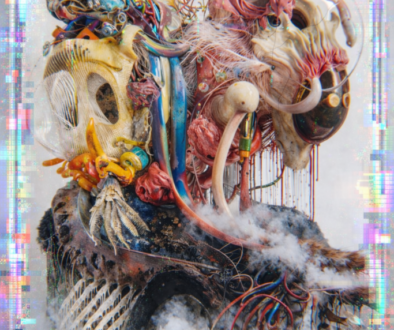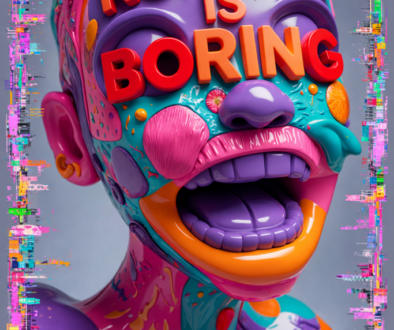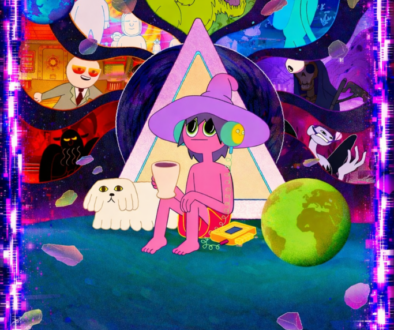
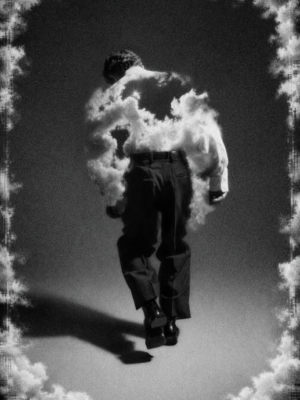
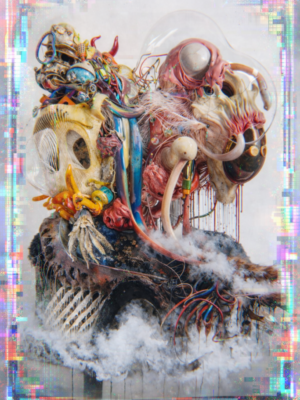
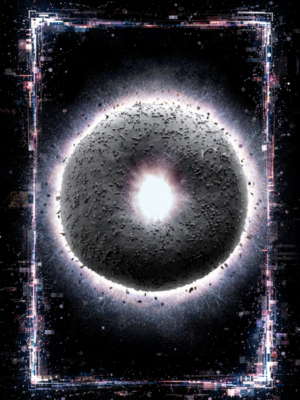



Artificial Lines of Flight appears within The Wrong Biennale, a decentralized digital art biennial built through online pavilions and physical embassies rather than one central venue. In this setting, the pavilion does not just present AI as a fashionable medium. It places AI inside a wider discussion about authorship, control, uncertainty, and collaboration, asking what changes once the image no longer feels like the direct property of one mind or one hand. The curatorial framing is especially useful because it treats the “line of flight” as a break from fixed systems, including fixed ideas of artistic intention. From the beginning, the pavilion argues that machine creativity matters less as proof of technical progress than as a disruption of stable authorship, and that disruption becomes clearer through the works themselves. Mike Petrakis’s Arteryficial Intelligence, for example, imagines AI as a living anatomy spreading through contemporary life, turning technology into something almost bodily rather than distant or neutral. That is a strong opening image for the whole exhibition, because it replaces the fantasy of clean control with a messier relation between human systems and machine structures.

That larger argument becomes concrete in Jie Shuai’s Poetry River, one of the clearest works in the pavilion for thinking about shared authorship. The piece invites visitors to enter a word, after which the AI generates a poetic line and folds it into a continuous machine-made stream of language. What matters here is not simply that a machine writes, but that the final result cannot be fully attributed either to the participant, the artist, or the system alone. The artist designs the structure, the viewer triggers the process, and the model produces the line, but none of those elements can claim full ownership over the outcome. The work becomes a good example of how AI art often shifts the artist’s role from sole creator to orchestrator of conditions. Instead of presenting a finished statement signed from one position, the work turns creation into an ongoing exchange in which authorship is distributed across interface, prompt, model behavior, and encounter. That makes it one of the pavilion’s strongest answers to the title question. The machine-made image, or in this case machine-made text, belongs less to a single owner than to a process that keeps unfolding.

This challenge to ownership becomes even sharper in works that refuse a final stable form. Domenec Miralles Tagliabue’s Movements is described as a generative film continuously re-edited in real time, which means the work never settles into one definitive version. That matters because traditional authorship depends heavily on the idea of a finished object: one completed film, one authoritative cut, one work tied back to one maker. But this kind of generative structure disrupts that logic by making process inseparable from form. Marcus Wallinder’s Forms of Escape fits especially well here, because it reinforces the pavilion’s central idea that form itself can become a way out of fixed authorship. In this context, escape is not only a theme. It is something built into the image’s condition, as images move away from stable identity, stable ownership, and stable interpretation. The artist remains central, but not as the owner of a sealed final image. The artist becomes a designer of systems, constraints, and transformations. Ownership weakens because the work is less a static possession than an active field of emergence.

Other works widen the question further by redistributing authorship beyond machine systems alone. Mizuho Nishioka’s Movement_17; Tasman Sea is especially important because it explicitly surrenders image-making control to the sea. The photographic apparatus is placed into the oceanic environment for long durations, allowing motion, atmosphere, and elemental force to shape the image directly. That move changes the argument in an important way. The question is no longer only whether AI shares authorship with the artist, but whether images now emerge from wider constellations of agency that include environment, duration, apparatus, and material conditions. Mark Cypher’s Polyrythmia supports this shift from another angle, exploring how life, work, and technology are structured by overlapping rhythms that exceed individual control. Together these works make the machine-made image feel less like a discrete synthetic output and more like a product of entanglement. In that context, ownership starts to look like the wrong word. Relation becomes more useful than possession. The artist sets an encounter in motion, but the image is shaped by systems and forces no single person can fully contain.

The pavilion also includes works where authorship breaks apart through recursion and machine perception itself. Blanche the Vidiot’s AIcology is one of the most revealing in this regard because it is built around feedback loops, self-referential seeing, and recursive transformation. Organic forms are captured, processed, described by recognition systems, fed into further image-generation processes, and sent back into new loops. The result is not a simple generated image but a chain of perception, translation, and distortion. That makes authorship difficult to locate in any singular way. The work is authored through a layered ecology of systems that look, interpret, and remake what previous systems have already seen. Paulius Sliaupa’s Winterteller extends this instability into a hyperreal landscape where scanned environments, lived experience, and uncertain futures blur together. In both cases, the exhibition moves away from the idea that the artist’s vision travels cleanly into an image. Instead, the image becomes the visible residue of multiple overlapping processes. What matters is not tracing everything back to one origin, but understanding how many different layers of mediation now shape what appears on screen.

The political force of the pavilion comes through most directly in Hyun Cho’s Ghost Killing, which makes clear that authorship is never only an aesthetic issue. The work stages a live computer simulation linking drone power structures and AI-driven platform industries, showing that once machine systems enter cultural production, questions of ownership also become questions of labor, power, and control. Who owns the image cannot be separated from who owns the infrastructure, who sets the rules of automation, and who absorbs the consequences. That gives the pavilion real weight. It does not celebrate distributed authorship as a purely liberating development. It shows that the collapse of singular authorship happens inside unequal technical and economic systems. Even when the image no longer belongs to one artist alone, it does not become free of power. It becomes more deeply entangled in it. This is why the show works so well as an argument. It does not simply claim that AI changes how art is made. It demonstrates, through examples, that AI changes how responsibility, agency, and ownership need to be understood.
By the end, Artificial Lines of Flight suggests that the machine-made image is best understood not as a possession but as a negotiation. Taken together, the works do not erase the artist, but they do remove the artist from the fantasy of total control. The artist becomes a setter of conditions, a builder of systems, and sometimes a witness to outcomes that exceed intention. That is the pavilion’s central strength. It does not ask whether machines can replace artists. It asks whether the very idea of ownership still makes sense once images are produced through distributed agency, technical mediation, environmental pressure, and recursive feedback. The answer it offers is not neat, but it is convincing. The machine-made image belongs to the entanglement that produced it.