

A hole is not only “nothing.” In art, it is often the most active shape in the room. It pulls your eyes toward the rim and makes you measure what you cannot touch. It pulls your ears toward the pause and makes you notice the space around sound. A hole can feel like an invitation, like a threat, or like a strange kind of relief. It forces attention to slow down and circle. It turns the missing center into a question you have to live with for a moment, instead of a problem you instantly solve. That matters right now because so many tools and platforms are built around the opposite impulse: smooth the surface, fill the gap, complete the picture, correct the silence. The works below keep returning to a different idea. Some gaps should not be repaired. Some absences are not mistakes. Sometimes the hole is the form that makes care possible.
This becomes immediately clear in Everything Everywhere All at Once, a 2022 feature film that begins as a family crisis and becomes a multiverse story. Evelyn Wang runs a struggling laundromat and is being audited, and her life already feels overfull. Her marriage is tired, her father disapproves, and her relationship with her daughter Joy is strained in the way that makes ordinary conversations feel like walking on glass. Then Evelyn learns there are countless alternate versions of herself across many realities, and she can “jump” into those lives and borrow their abilities. The film makes the multiverse feel like overload, not like freedom. Out of that overload comes the “everything bagel,” created by Joy’s alternate self, Jobu Tupaki. It is a bagel piled with “everything” until it collapses into a dark center, and it becomes an invitation to stop trying. The bagel is not presented as a mystery to solve. It is presented as a temptation, the feeling that if you could just step into the center, the noise would finally end. Evelyn understands it as her daughter’s despair made visible. The film’s emotional question becomes simple and painful: can love compete with the pull of giving up?
The “rock universe” is the film’s clearest counter-move to that pull, and it helps to know what it is. At one point, the story jumps to a reality where Evelyn and Joy are not people at all. They are just two rocks sitting on a desert cliff under a wide sky. Nothing “happens” in the usual movie sense. There is no action, no faces, no fast cutting, and almost no sound. The rocks communicate through subtitles, as if their thoughts are appearing silently on the landscape. The scene is funny because it is so unexpected, but it is also deeply calming. It is the movie taking a breath inside its own chaos. By stripping away almost everything, it creates a quiet hole where the characters can be together without trying to fix each other. That pause matters because it models the film’s answer: the way out of the void is not a perfect solution, but a decision to stay present, to keep returning, to let the gap exist without surrendering to it.
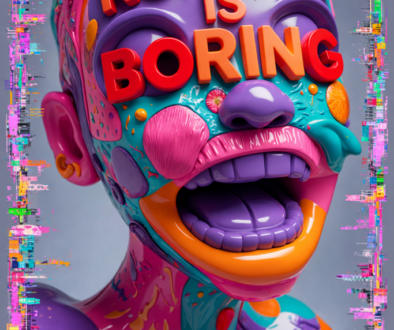
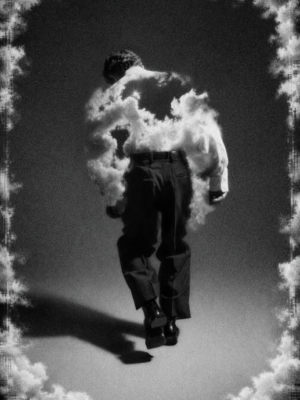
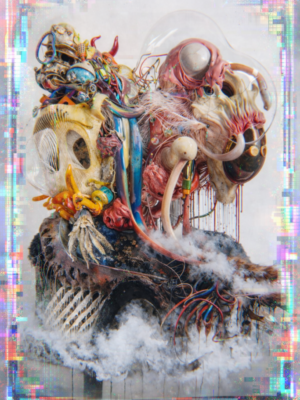
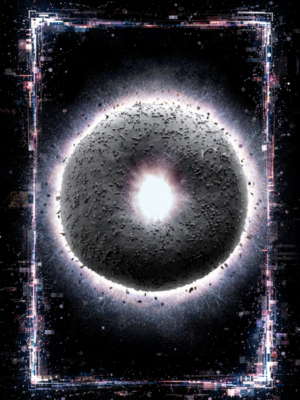
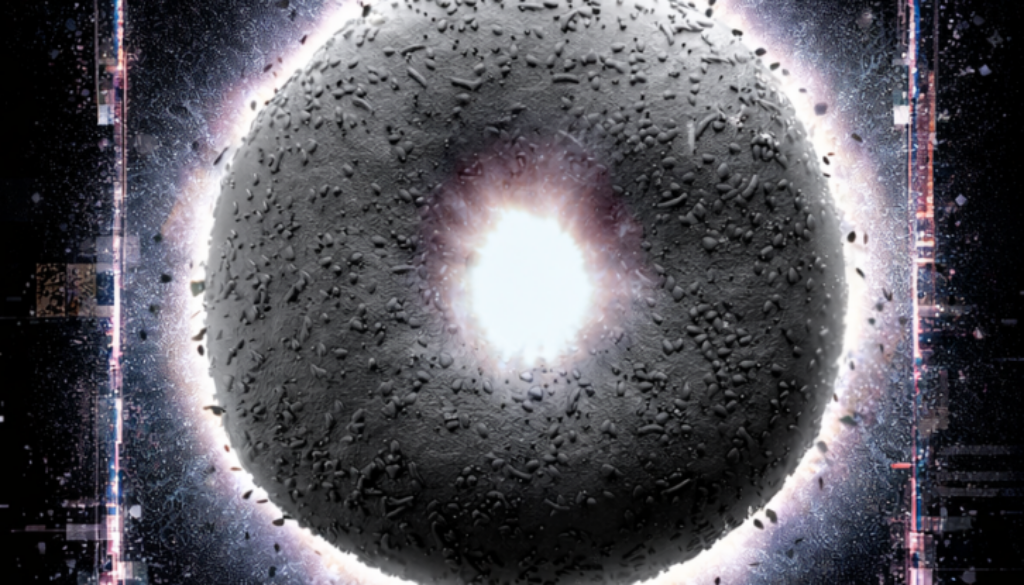
If the film shows a hole as an emotional center you cannot patch, The Doughnut (W)Hole shows a hole as a curatorial stance you should not patch. This website is an online art pavilion within The Wrong Biennale, a large digital art biennale made from many pavilions hosted across the internet. The pavilion’s basic move is to treat holes and wholes as more than a clever theme. It frames the hole as something that can be meaningful precisely because it stays open. In a moment when AI tools are often marketed as gap-fillers, able to regenerate images, voices, and memories, this pavilion leans toward a more cautious, more ethical question: what happens when filling becomes a way of erasing the truth of loss? What happens when smoothness becomes a kind of violence? The site’s structure supports that question. You enter an Entrance Hall and choose among three parlours, Pot(W)Holes, Memory(W)Holes, and Worm(W)Holes, moving through the pavilion by clicking thumbnails and backing out again. You never hold the entire show at once. That partial view is not a design flaw. It is the point. The pavilion makes the gap visible as a condition of digital life, and then refuses to “fix” it.
Pot(W)Holes is where the pavilion places the temptation to smooth and accelerate. It deals with disruption in how images get made, how authorship gets blurred, how speed can flatten craft. The ethical question here is not “is AI good or bad,” but “what gets lost when we value seamless output over slow looking.” One of the pavilion’s sharpest gestures is the idea of a doughnut that fails to form its hole, using light and shadow to erase depth and create an uneasy fullness. It suggests that the absence of gaps can be disturbing too. If everything is filled, where does breath go? Where does uncertainty go? Pot(W)Holes makes room for the discomfort of living inside a system that wants to complete everything.
Memory(W)Holes takes the ethical focus into grief and family history, where the cost of filling can be most personal. This parlour asks what it means when technology offers “synthetic memories,” simulated voices, reconstructed faces, plausible scenes from a past you cannot revisit. The pavilion points to works that engage with AI history, with conversations with AI “doubles,” and with deepfake family material, and the through-line is not spectacle. The through-line is the gap between record and life. A recording can preserve an image, but it cannot preserve lived time. A generated voice can mimic a person, but it cannot restore a relationship. In this parlour, the hole is not a glitch to patch. The hole is the truth of loss, and the pavilion treats that truth as something you must not overwrite with a smooth substitute.
Worm(W)Holes shifts from personal memory to larger systems, but the ethics remain. The pavilion uses cosmic language, black holes and white holes, to talk about absorption and output, about how systems take in vast material and return patterned surfaces. Here the danger of filling becomes the danger of false coherence, the feeling that because something looks patterned, it must mean something. Worm(W)Holes pushes you toward a more careful relation to pattern. It suggests that coherence can be temporary, that meaning can flicker, that letting things remain unresolved might be more honest than forcing a tidy story. This parlour treats the hole as a space where you can notice structure without pretending it is complete.
After a film and a pavilion that both refuse easy closure, John Cage’s 4′33″ makes that refusal audible. This is a musical composition from 1952 performed in a concert setting, where the performer does not play the expected notes for the duration. People often call it “silence,” but the experience is full. The audience hears breathing, shifting bodies, distant noise, the building itself. What Cage refuses is the idea that the gap needs to be filled with intentional sound in order to be meaningful. The hole is the piece. It teaches that emptiness is never empty, and that listening is not consumption. Listening is attention. The work also has an ethical edge: it does not let you escape into pure entertainment. It makes you share the room, share the time, share the fact that you are present with other people.
Anish Kapoor’s Descent into Limbo makes the same refusal physical. This 1992 installation places a dark circular void in the floor of a gallery space. It can look flat at first, like a black disk, until your perception starts to stutter and you cannot easily confirm depth. Your feet are on solid ground, but your eyes do not fully trust the ground, and that mismatch makes you slow down. Kapoor refuses to give you the comfort of certainty. The hole cannot be solved by quick looking. It forces care, literal carefulness, in how you approach. It is a work about the ethics of attention: you cannot rush the void without risking yourself, and the work makes that risk part of its meaning.
The games Portal and Outer Wilds turn this ethical stance into action. In Portal (2007), you play as Chell, trapped in a sterile testing facility run by an AI called GLaDOS. You are given a portal gun that creates two linked openings on flat surfaces, letting you step through walls and redirect falls into speed. The hole here is not a danger you erase. It is a structure you learn. The game rewards patience and understanding over brute force. It teaches that the gap is not always a problem. Sometimes the gap is the only way forward, if you respect its rules. Outer Wilds (2019) is an exploration game in a looping solar system where time resets after a short span. You return again and again with only your knowledge intact. The game’s black hole on Brittle Hollow is terrifying at first, then it becomes legible, even useful, as you learn how it connects to the rest of the system. Both games refuse a common fantasy of “fixing” the unknown. They turn the unknown into something you approach carefully, learn slowly, and live with.
Junji Ito’s “The Enigma of Amigara Fault” shows the darkest consequence of confusing filling with truth. This horror manga short story begins after an earthquake reveals countless human-shaped holes in a mountainside. People gather to look, and then curiosity becomes compulsion. Individuals feel a powerful urge to enter the hole that fits their body perfectly. The terror is not only what might happen inside. The terror is the desire to fit, to belong, to be completed by a perfect match. Ito turns that desire into a trap. The hole feels like destiny, and that is exactly why it is dangerous. In ethical terms, it is a nightmare about surrendering to the promise of completion, about choosing the smooth certainty of the fit over the messy uncertainty of staying outside.
Together, these works form a single argument without preaching it. They show that the urge to fill every gap can be a way of avoiding reality. The film turns the void into a temptation to disappear, and then insists that care is not a fix, it is a return. The Wrong Biennale pavilion refuses the fantasy that AI can replace loss without cost, and it treats the gap as something that should remain visible because it is part of the truth. Cage refuses to fill silence with performance, forcing attention outward into the world. Kapoor refuses to fill perception with certainty, forcing the body to approach with care. The games refuse to “patch” the unknown, teaching instead that you learn by living with openings and repeating your approach. Ito turns the desire for perfect completion into horror. The hole, across all of this, is not emptiness. It is an ethics. It asks what you do when something cannot be restored, cannot be made seamless, cannot be solved. And it suggests that sometimes the most human response is not to fill the center, but to stay near it, to build meaning around it, and to let the gap remain honest.