






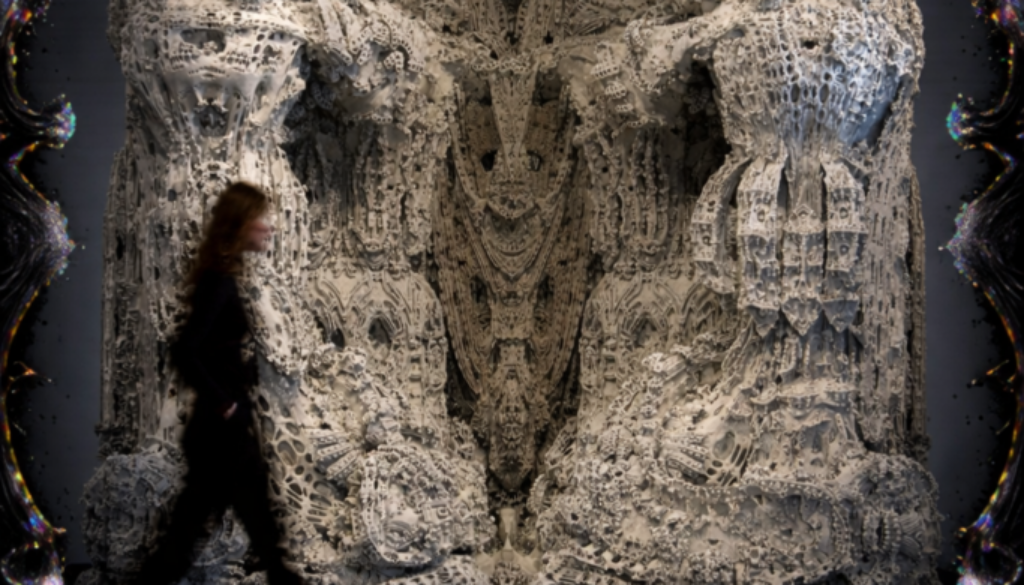
Michael Hansmeyer’s work changed architecture by treating computation not as a hidden technical aid but as a source of form in its own right. Before his projects gained visibility, digital tools in architecture were often discussed in terms of efficiency, optimization, and streamlined production. Hansmeyer pushed in another direction. He used algorithms and fabrication systems to pursue excess, density, intricacy, and sensory overwhelm, bringing back qualities that much of modern architecture had treated with suspicion. His columns, grottos, walls, and towers do not simply look unusual. They propose that digital design can generate a new architectural language, one where ornament is not applied after the fact but produced from the same generative logic that shapes the whole structure. That shift is why his work feels like more than experimentation. It opened a different future for architecture, one grounded in code yet aimed at wonder, texture, and perception.

A clear starting point is the long-running Subdivided Columns project, which established the core of his approach. Rather than sketching a column and decorating it later, Hansmeyer developed a process in which subdivision generates the overall geometry, the secondary formations across the surface, and the ornamental articulation at once. The project began with column prototypes shown at ETH Zurich in 2010 and expanded into later installations such as The Sixth Order for the 2011 Gwangju Design Biennale and the Astana Columns shown at Expo 2017 and then at the Grand Palais in Paris. What made these works important was not only their appearance but the design logic behind them. Hansmeyer argued that such forms were effectively undrawable through conventional means, and that working with generative systems introduced surprise into design itself. The architect no longer dictated every contour directly. He set rules, adjusted processes, and responded to results produced through an iterative exchange with the machine.
That change in authorship is central to understanding why his work had such impact. In many digital design workflows, the computer still serves mainly as a representational instrument, helping architects model what they already imagine. Hansmeyer used it to reach what could not be fully imagined in advance. His own descriptions of the subdivided forms emphasize that they exceed direct human drafting and even direct foresight, which turns design into a feedback loop between person and system. That idea has become common in discussions of generative design, but his projects gave it a strong architectural image at a moment when those conversations were still taking shape. He made the argument visible. A Hansmeyer column is compelling not only because of its profusion of detail, but because it embodies a new division of creative labor. The designer does not vanish, but the process no longer revolves around total manual control. Architecture becomes less about drawing a final object and more about composing the conditions under which form can emerge.

The Digital Grotesque projects carried that idea into space at full scale and made it impossible to dismiss as a formal curiosity. Digital Grotesque I, developed with Benjamin Dillenburger, explored a human-scale enclosed environment printed in sandstone, while Digital Grotesque II expanded the concept into a 3.45-meter-high, seven-ton grotto that premiered at the Centre Pompidou in 2017 and entered the museum’s permanent collection. These works were not just intricate surfaces enlarged into rooms. They compressed vast amounts of geometric articulation into built form and turned ornamental density into an immersive condition. The viewer does not stand in front of decoration and decode it from a distance. The viewer enters a space where walls, columns, cavities, and textures are all caught in the same recursive logic. Hansmeyer described these grottos as spaces between order and chaos, between the crafted and the grown. That ambiguity is part of their force. They feel historical and alien at once, as though ornament had been rediscovered through an entirely different civilization of tools.

Digital Grotesque II also made another decisive move by pushing the computer beyond pure generation toward evaluation. According to the project description, the system was not only producing formal options but learning to assess and optimize them, which shifted the collaboration between architect and machine into a more autonomous register. That is a radical proposition in architecture, especially in a work with no straightforward functional target like a grotto. The project raises the question of what a machine should optimize when the goal is not structural efficiency or cost reduction but atmosphere, perceptual richness, and affect. Hansmeyer’s answer was not to turn architecture into engineering by other means, but to insist that aesthetic intensity can itself become a field of computational research. In this sense, his work anticipated later debates about machine learning and creative judgment, yet it did so through built form rather than theory alone. The resulting architecture is deeply physical, but it also stages a new idea of design intelligence, one in which computation participates in the search for beauty rather than merely executing instructions.
His work is just as important for the way it reopens architectural history without falling into simple revivalism. Projects such as Arabesque Wall and Muqarna Mutation draw on ornamental traditions that long predate modern computation, but they do not imitate them as heritage motifs. Arabesque Wall takes the geometric logic of arabesque ornament and subjects it to iterative folding and surface division until millions of microscopic facets emerge, producing a 3D-printed wall that feels both abstract and suggestively figural. Muqarna Mutation, commissioned for the Mori Art Museum’s Future and the Arts exhibition, rethinks the historical muqarnas ceiling as an algorithmically designed, robotically fabricated structure that grows out of an existing central column and transitions toward the room’s ceiling. In both cases, Hansmeyer does not quote the past in a decorative way. He extracts deep compositional principles from older ornamental systems and uses contemporary fabrication to make them proliferate beyond historical limits. That is a major part of his contribution. He showed that computation could return architecture to ornament without returning it to pastiche.

The recent White Tower, or Tor Alva, demonstrates how far this research has moved from installation and exhibition into architectural construction. Designed by Hansmeyer and Benjamin Dillenburger for Mulegns in the Swiss Alps, the tower has been described by ETH Zurich and the project site as the world’s tallest 3D-printed structure. Official project material describes a 30-meter tower composed of 32 unique 3D-printed columns across four levels, with a dome-like upper structure and 124 printed elements in total. What matters here is not only scale, though the scale is significant. It is the fact that the ornamental column language becomes structural, load-bearing, and public. ETH Zurich’s account explains that robotic fabrication, custom concrete development, and embedded reinforcement made it possible to produce branched columns that would be difficult to realize with conventional casting. Hansmeyer’s earlier work often looked like a challenge directed at architecture from its margins. Tor Alva shows that the challenge can stand up as architecture itself, in the full sense of the word.
Another reason his work feels revolutionary is that it refuses to settle into one medium or one fabrication ideology. The subdivided columns used laser-cut sheets stacked into dense forms. The Digital Grotesque grottos exploited 3D binder-jet sandstone printing. Arabesque Wall translated algorithmic ornament into sand-printed architectural mass. Tor Alva uses robotic concrete extrusion with structurally reinforced printed columns. Across these projects, the point is not loyalty to a single machine but a consistent effort to find the formal possibilities latent in each process. Hansmeyer treats fabrication methods as generators of architectural language. In Tor Alva, for example, ETH describes how the fluidity of the extruded concrete enabled droplet-like relief patterns and spiral surface textures, while the printing process allowed complex curves and custom elements without the burden of conventional formwork. That way of working changed how many people think about digital fabrication. Instead of asking how new tools can imitate familiar construction more quickly, Hansmeyer asks what kinds of architecture become possible when the tool is allowed to speak in its own accent.

What he ultimately challenged was a century-old prejudice built into much architectural culture: the idea that ornament is superficial, irrational, or secondary to serious design. Hansmeyer’s projects suggest the opposite. Ornament can be a primary organizational system, a spatial engine, and even a structural proposition. It can be computational without becoming cold. It can be historically resonant without becoming nostalgic. It can be materially precise without losing mystery. This is why his work attracted attention beyond architecture schools and fabrication labs, appearing in museums, biennales, and major cultural venues. The projects offered something architecture had often denied itself: a permission to be sensuous and intellectually rigorous at the same time. He did not simply add complexity for spectacle. He used complexity to test how far contemporary tools could push the relationship between geometry, perception, and cultural memory. The result was a body of work that made digital architecture feel less like a technical specialty and more like a new chapter in form itself.
Hansmeyer’s importance lies there, in the way he widened architecture’s horizon. He showed that algorithms could generate more than efficient envelopes or I parametric surfaces. They could produce spaces of astonishment, objects of bewildering refinement, and structures that reconnect architecture with ornament, narrative, and the pleasure of looking. His work has not replaced mainstream building practice, and it was never likely to. Its force comes from demonstrating that architecture does not have to choose between advanced technology and visual intensity, between computation and cultural depth, between fabrication research and beauty. That is the mark of a real shift. Once these projects exist, architecture cannot pretend that standardization is the only mature future available to it. Hansmeyer opened a parallel path, one where code can elaborate rather than simplify, where machines can extend imagination rather than flatten it, and where buildings can once again feel as if they were made to leave people staring upward.