

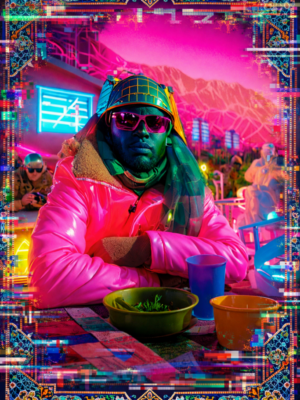


Afrofuturism is often mistaken for a style built out of chrome, neon, outer space, or sleek machinery, but those surfaces only reveal a small part of what it does. At its core, it is a way of imagining Black life outside the cultural limits imposed by racism, colonial history, and narrow definitions of modernity. It joins speculative thinking with memory, technology with ancestry, and fantasy with political desire. The point is not simply to place Black artists inside already existing visions of tomorrow. The point is to rebuild tomorrow through Black ways of seeing, sounding, dressing, moving, and remembering. That is why Afrofuturism has become so central to pop culture. It turns the future from a distant territory shaped by other people’s assumptions into a field where Black identity can appear powerful, experimental, sensual, wounded, luxurious, and fully alive without being reduced to one role.
Another important part of Afrofuturism is the way it changes the relation between past and future. In ordinary stories of progress, the future is often imagined as a clean break from history, as though modernity requires forgetting what came before. Afrofuturism works in the opposite direction. It carries history forward and lets inherited memory remain active inside new worlds. Slavery, colonial violence, migration, erasure, spiritual continuity, and cultural survival do not disappear. They are transformed into material for invention. That is why Afrofuturist works often feel layered rather than simply futuristic. A costume can look ceremonial and advanced at the same time. A city can feel ancient in spirit and radically new in structure. A song can sound electronic while still carrying grief, ritual, or collective memory. The future in this tradition is not built through cultural amnesia. It is built through pressure, remix, return, and refusal.
That framework helps explain why Black Panther became such a defining screen image of Afrofuturism. The film’s achievement was not only that Wakanda looked advanced, but that its vision of advancement never required Africa to disappear in order to seem modern. The city, the royal palace, the mountain landscape, the transit systems, and Shuri’s lab all present a future grounded in African cultural logic rather than detached from it. The film’s production design was shaped around the idea of Wakanda as a futuristic country grounded in its past, and the costume design reinforced that structure by giving its tribes distinct material and color identities. The River Tribe was marked in green, the Border Tribe in blue, the palace and Panther line in black and royal purple, and the Jabari in wood-toned earthiness. The result is a world that feels organized, coded, ceremonial, and lived in, not like a generic science-fiction city with African decoration applied afterward.
The movie deepens that visual world by constantly placing technology beside ritual, kingship, and ancestry. T’Challa’s rise is framed through challenge, succession, and the authority of inherited role, while Shuri’s inventions give Wakanda a bright, playful scientific language that includes remote systems, stealth footwear, and the upgraded suit that absorbs kinetic energy and redistributes it. Even at its most technologically dazzling, the film keeps returning to spaces like the waterfall challenge, the throne room, and the Ancestral Plane. Those scenes prevent Wakanda from becoming a fantasy of pure machinery. They make clear that Black futurity here is social, spiritual, and political all at once. The conflict with Killmonger sharpens that further, because he brings the pain of the wider Black diaspora into Wakanda’s enclosed brilliance. The future in the film is not just a triumphal image. It is also a contested moral question about power, responsibility, belonging, and historical fracture.
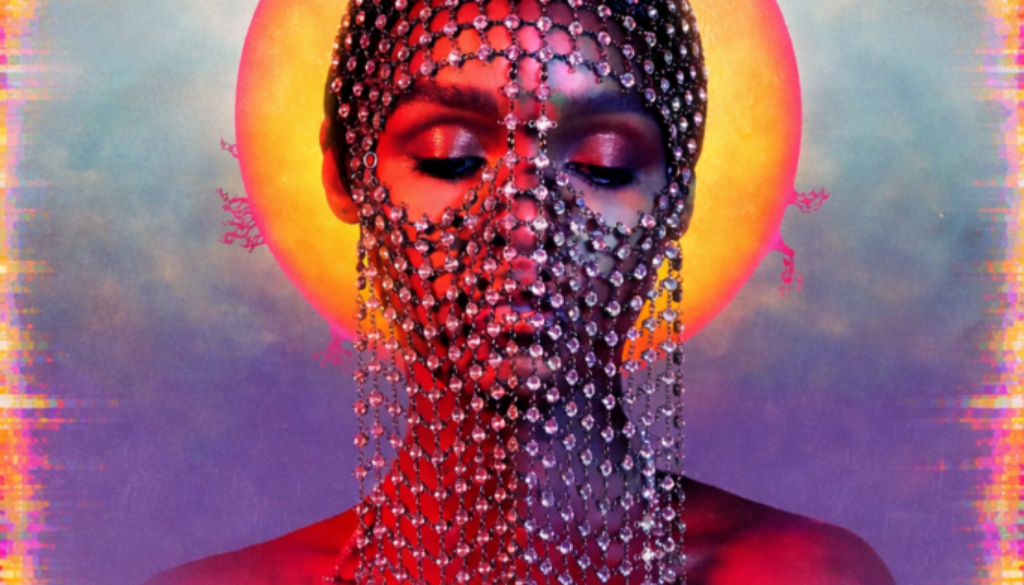
Janelle Monáe turns Afrofuturism inward, away from state power and toward the intimate territories of identity, desire, surveillance, and self-invention. Dirty Computer was presented as an emotion picture, a narrative film and accompanying album, and that hybrid form already reveals the scale of her ambition. The future in this project is not a distant backdrop. It is a system that classifies, erases, punishes, and tries to smooth out anyone whose body or desire falls outside dominant norms. Monáe uses that world to transform Black queerness, Black femininity, and emotional vulnerability into the center of the frame rather than its margin. The songs do not float free from the visuals. They live inside a larger architecture of memory wipes, coded intimacy, and social control. Afrofuturism in her work becomes a way of asking who gets labeled dirty, who gets watched, and who has the right to rewrite the terms of visibility.
The music videos from that era show how flexible that strategy can be. “Make Me Feel” turns a nightclub into a glowing field of fluid attraction, with Monáe moving between Tessa Thompson and a male partner in a scene built around color, flirtation, and refusal of rigid sexual categories. “Django Jane” creates the opposite atmosphere, placing her on a throne in white, surrounded by tightly controlled formations that turn Black feminist self-possession into a futuristic image of discipline and sovereignty. “PYNK” softens the mood into a desert dream of intimacy, group movement, and stylized feminine symbolism, with the famous pink trousers making the body itself the governing shape of the image. None of these videos relies on one fixed futuristic code. Together they show Afrofuturism working as a set of visual tools for inventing freedom in different forms, whether erotic, political, collective, or bodily. Monáe’s world is futuristic because it makes otherness generative instead of apologetic.
Beyoncé approaches Afrofuturism through spectacle, ceremony, lineage, and control over visual scale. Black Is King is central to that approach because it builds a world where family, procession, costume, landscape, hair, gesture, and symbolic movement all become part of a future-facing Black grandeur. The project presents itself as a visual album inspired by The Lion King: The Gift, and it centers on Black experience, Black excellence, and the search for one’s crown. Its power comes from the way it treats inherited culture as something active and world-making rather than archival. The film’s visual language keeps returning to richly staged group formations, monumental settings, ornate dress, and images of Black continuity that feel both ancestral and forward-moving. It does not need spaceships or digital cities to feel futuristic. Its futurity comes from the scale at which it presents Black memory, kinship, and beauty as forces large enough to organize an entire world.
That visual logic becomes more metallic and urban in the Renaissance era, especially in the live concert and its film version, where machine imagery, choreographed collectivity, and Black queer nightlife history are fused into one immense spectacle. The stage world has been described as chrome-futuristic, and the details make that plain: towering robot arms frame “Cozy,” the giant silver horse from the album cover becomes a moving emblem when Beyoncé rides above the audience, and a metallic tank-like vehicle extends the album’s industrial glamour into the live space during “Savage” and “Partition.” The desk setup and bee costume in “America Has a Problem” push the whole thing into camp, authority, and futuristic theater. At the same time, the show gives room to ballroom artists and voguers, while the crowd’s silver dress code turns the audience into part of the visual field. The future here is not solitary. It is crowded, rhythmic, stylized, and socially alive.
Flying Lotus brings the discussion back to music, and his work shows how Afrofuturism can exist at the level of rhythm, texture, and sonic space even when no grand visual narrative is present. His records often sound like memory passing through circuitry, with jazz improvisation, bass pressure, drum programming, electronic noise, and cosmic drift all pressing against one another. On Cosmogramma, samplers and machines share space with strings, harp, bass, trumpet, and saxophone, so the album already embodies one of Afrofuturism’s central moves: it refuses to separate digital process from Black musical lineage. “Zodiac Shit” lopes forward on heavy low end, syncopated percussion, eerie synth presence, and an atmosphere that feels both bodily and extraterrestrial. “…And the World Laughs with You” breaks the voice into strange layers until it sounds like data, ghost, and human breath at once. “MmmHmm” and “Do the Astral Plane” pivot through groove, fragmentation, and astral lift without ever settling into ordinary stability.
That same unstable charge runs through “Never Catch Me,” one of the clearest examples of Afrofuturist music in his catalog. The track pairs fast, skittering, high-velocity production with Kendrick Lamar’s meditation on death, fear, transcendence, and life beyond the body. It never settles into a comforting groove. It keeps surging forward, as if the beat itself were trying to outrun mortality. The music feels airborne and anxious at once, which gives it a strange sense of spiritual propulsion. With Flying Lotus, the future does not arrive as polished certainty. It appears as broken pulse, warped atmosphere, jazz memory, digital interference, and the feeling that Black sound is transmitting from somewhere both ancient and not yet fully here. That is what makes his role so important in this larger field. He keeps the futuristic from becoming too clean, too stable, or too easily packaged. He lets it stay difficult, haunted, and open.
What gives this whole cultural moment its force is not just visibility, but authority over imagination itself. These works do not ask to be inserted politely into someone else’s version of tomorrow. They produce their own worlds, their own textures, their own emotional scales, and their own rules for what counts as advanced, beautiful, sensual, or powerful. They do not treat Black life as something that only belongs to realism, injury, or proof. They let it expand into architecture, coded desire, ritual, chrome fantasy, ecstatic rhythm, spiritual unease, and forms of collective image-making large enough to alter the mainstream from within. Once Afrofuturism reaches that level, it stops looking like a trend. It starts to look like a struggle over who gets to shape reality before reality arrives.