



At its best, Kojima’s work erases the line between watching and acting. You are not taken out of play to be told what matters. You are led into choices that already feel like scenes, beat by beat, until filmcraft and game design become the same language.
A lot of games chase “cinematic” as a look. They chase shallow depth of field, dramatic lighting, prestige performances, and the promise that a cutscene could stand on its own as film. Kojima’s cinematic influence is more interesting because it is not only visual, and it is not only about longer story sequences. It is functional. He treats film grammar as a set of design tools for guiding attention, shaping tension, and controlling the flow of information while you still have agency. His games do not simply borrow cinema’s surface, they translate cinema’s craft into rules, pacing, and perception. If you want proof, you can find it in how Metal Gear Solid uses suspense like a thriller and how Death Stranding uses duration like a long take, even when you are fully in control.
Start with the camera, not as a piece of technology but as an idea. In cinema, the camera decides what counts. In games, the camera is also where you live, and that makes it a powerful lever. Metal Gear Solid is often remembered for cutscenes, but its most cinematic power comes from playable tension built through viewpoint and information. Stealth already behaves like cinematography because it is about visibility, angles, and what stays outside the frame. Guard vision, chokepoints, and patrol routes turn ordinary geometry into suspense staging, where you feel the pressure of being seen even when nothing is shooting at you. The “shot” becomes a rule. The player learns to think like a director and like a character at the same time, reading space for sightlines and exits the way a thriller reads a room for threats and tells.

Cinema’s other great tool is editing, the control of rhythm and information. Games cannot edit you in quite the same way because players interrupt sequences, change tempo, and refuse the “correct” timing. Kojima’s solution is not to abandon editing logic but to rebuild it as systems of anticipation and release. Look at Metal Gear Solid V: The Phantom Pain and how it stretches tension through approach, infiltration, and consequence. The editing is not only in the cutscenes. It is in how the game spaces out knowledge, what it lets you glimpse before you commit, how it allows quiet time to expand until it becomes pressure, and how it snaps you into a new situation when your plan breaks. The rhythm is authored, but it is authored around your choices, which is why the experience can feel directed without feeling identical from player to player.
Film directors also talk about blocking, which is the choreography of bodies in space. Game designers talk about encounter design, routes, and affordances. Kojima often makes those ideas overlap so that movement is not only efficient, it is staged. In Metal Gear Solid V, enemy outposts can feel like sets because the patrol patterns and sightlines create readable beats. You observe, you predict, you execute, then you improvise when the “scene” changes. That shift from rehearsal to improvisation is a very cinematic pleasure, because it mirrors the way a suspense sequence escalates. First you understand the space, then the space starts to fight back, and suddenly you are not just solving a puzzle, you are surviving a sequence.
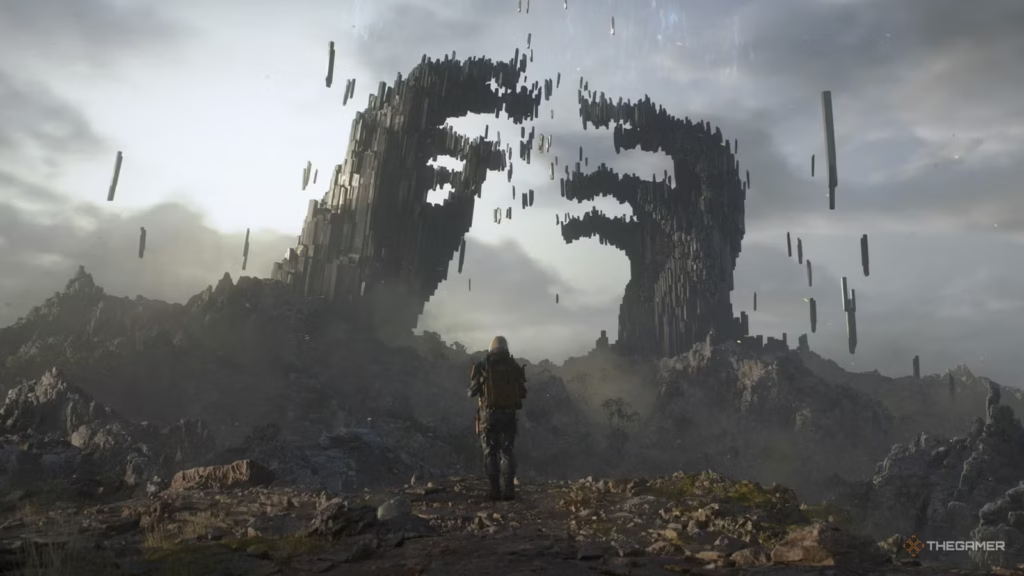
In Death Stranding, blocking becomes the whole thesis. The landscape is not a backdrop, it is the director. Terrain, load, and stamina force you to inhabit time, and your route planning starts to resemble shot planning. You scan a ridge line and a river crossing the way a director scans a location, asking what the world will allow, what it will punish, and what kind of tension the path will produce. The game’s slow pace stops being an absence of action and becomes a formal choice, closer to a long take where meaning accumulates through duration rather than spectacle. When music arrives after a long stretch of silence, it lands the way a needle drop lands in film, not because it is loud, but because you have lived long enough in the quiet for the cue to feel like a change in emotional weather.

Sound is another place where filmcraft becomes design. A cue can turn neutral space into dramatic space instantly, not by adding plot but by changing expectation. Kojima uses music to mark thresholds, warn of pressure, and convert routine motion into a sequence with stakes, while still letting you choose how to move. He also uses silence as a form of framing. Silence makes you listen harder, notice more, and imagine what you cannot see. In stealth, that can become paranoia. In Death Stranding, silence becomes isolation, then relief when sound returns. Even radio style communication in his games can function like a camera move, compressing the world into a channel of information that changes what you notice afterward, because your understanding of the scene has been rearranged without a single button prompt telling you what to feel.
Performance matters in the same practical way. Celebrity casting can be a marketing signal, but performance capture also makes character intention readable. In games, players constantly interpret faces and bodies for danger, trust, and motive, and film acting is built for that kind of legibility. Kojima leans on micro-expressions, posture, timing, and lingering close observation to create emotional clarity, then hands control back to the player so that clarity becomes pressure. You are not only told what a moment means, you feel what it asks of you next. This is where his “cinematic” approach is strongest: not when you watch, but when the watching sharpens what your doing will cost.
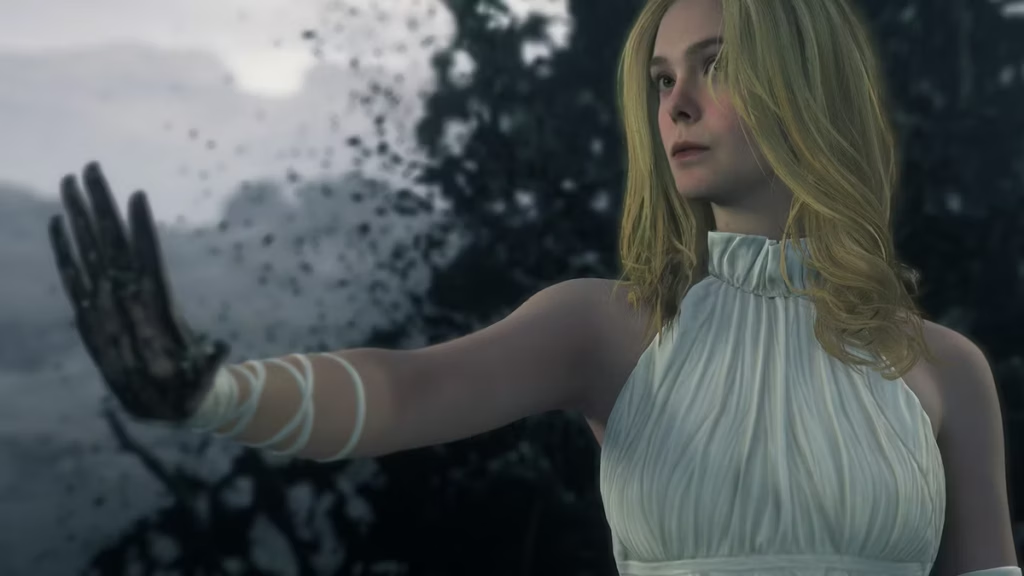
Kojima’s stories are also known for turns that change what you think the game is about. The cinematic influence here is not only the twist itself. It is the way the twist reorders your memory. A great film twist can make earlier scenes feel different without changing the footage. A game can do that more violently because earlier “scenes” were actions you performed. When a story reframes a mission, it reframes your past choices and your sense of complicity. That is one reason his themes around control, surveillance, and manipulation land so strongly in the Metal Gear lineage. The method matches the message, and the player feels that match personally because the medium makes the theme experiential.
None of this is effortless, and the approach has tradeoffs. When cinematic direction becomes too heavy-handed, players can feel interrupted rather than guided. When exposition stretches, rhythm can flatten. When cutscenes become dense, agency can feel intermittent. Those criticisms are real, and they point to the difficulty of the hybrid Kojima aims for. He wants the emotional precision of cinema and the responsibility of interactivity in the same moment. The reason his best work stays influential is that, at peak, he makes authored intensity feel compatible with choice. He makes direction feel like a current you swim in rather than a leash you are pulled by.
Kojima’s legacy is not simply that games can look like movies. It is that cinema contains a mature vocabulary for controlling attention, tension, and meaning, and that vocabulary can be translated into mechanics, pacing, and structure. Framing teaches priority. Rhythm teaches suspense. Blocking teaches space. Sound teaches expectation. Performance teaches legibility. When those tools are rebuilt for interactivity rather than pasted on top of it, you do not get a game pretending to be a film. You get a game using filmcraft to become more fully itself. At its best, Kojima’s work erases the line between watching and acting, and you realize you have been playing the edit, the frame, and the scene all along.