



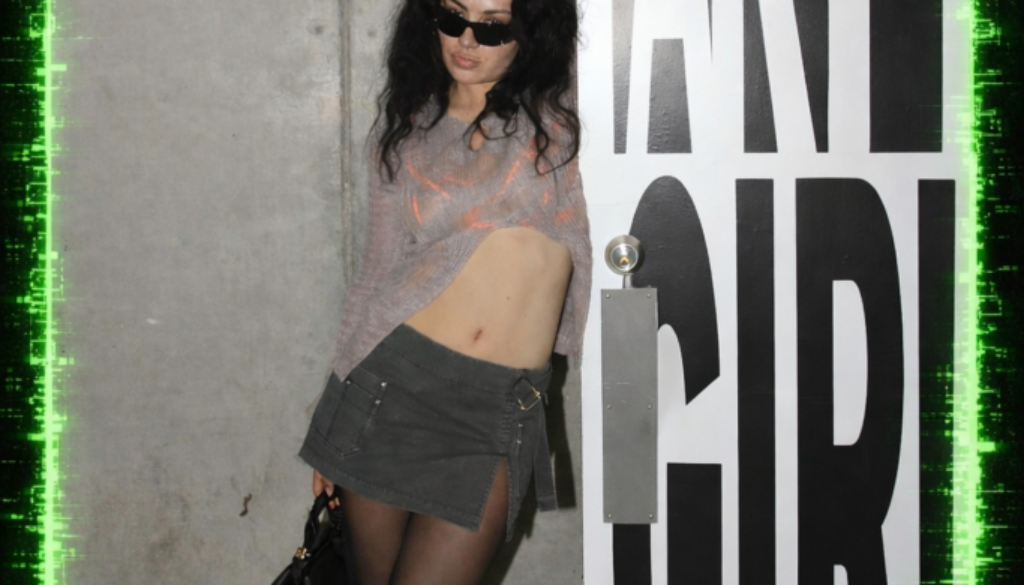
Auto-Tune is personified on Brat turning vocal processing into storytelling rather than polish. The mockumentary The Moment extends this onscreen, making pop persona the story itself.
Auto-Tune used to be treated like invisible labor, the kind of backstage adjustment you were not supposed to notice unless something went wrong. In the older etiquette of pop, hearing the tool was framed as evidence of failure, either the singer failed, or the production failed to hide its seams. That etiquette collapses the moment a record decides the seam is the point. The second pitch correction stops trying to pass as nature, it becomes readable, and once it is readable it can carry motive, mood, and narrative weight. This is not new in the sense that pop has never been unmediated, the microphone is already a kind of fiction machine, and the modern vocal has always been an edited portrait, compressed and arranged into a persuasive self. What feels new is the confidence with which the mediation is allowed to speak, not as a guilty giveaway, but as a voice with intent. Cher’s “Believe” made the effect famous as a hook, T‑Pain turned it into a performable charisma, Kanye used it as estrangement you could sing along to, and then the dialect spread outward until it was no longer a special effect but a default way of being inside a song. The difference between “correction” and “character” is simply whether the work wants you to ignore the tool or follow it, and lately pop keeps asking you to follow it.
Brat is a record that treats the processed voice as an agent moving through scenes, not a coat of paint applied afterward. The run from “360” into “Club classics” is practically a thesis statement, a voice calibrated for the room, bright, hard, and social, like the personality you put on when you enter a party already halfway in progress. “Von dutch” pushes that calibration into a kind of weaponized crispness, the vocal feels like it is built to cut through a crowd, to be repeated, to survive distance and noise. Then the album keeps shifting the function of the same tool. “Sympathy is a knife” makes tuning feel like a defensive posture that still bleeds, “I might say something stupid” lets the vocal sit in that precarious space where self awareness becomes a performance you cannot exit, and “Everything is romantic” turns sheen into longing, the gloss and the ache happening at the same time rather than in separate layers. Even the emotional center of the record uses vocal treatment as storytelling: “So I” is grief rendered in a language that still belongs to the pop machine, and “Girl, so confusing” is an interpersonal scene where the voice sounds like it is negotiating not just another person, but the narrator’s own public self. When you get to “I think about it all the time,” the intimacy is almost mundane, and that mundanity lands as a twist precisely because the record has trained you to hear the voice as designed, as if the most radical thing it can do is admit how ordinary a thought can be once it stops auditioning for virality. “365” ends by snapping the persona back into motion, and the effect reads less like a return to “bangers” and more like the protagonist reentering the role it knows it can play. The tuning is not there to make Charli sound perfect, it is there to make the act of sounding like Charli into the drama itself.

If Brat makes Auto-Tune into a narrator, The Moment makes that idea literal by translating it into camera grammar and plot mechanics. The film is a mockumentary in which Charli plays a fictionalized version of herself in the aftermath of the cultural spike that people shorthand as “Brat Summer,” and the central tension is not simply fame in the abstract, but the panic of trying to extend a peak that the culture has already begun to treat as past tense. The mockumentary form matters because it is already a genre about the coercion of “realness,” the camera insists you be yourself, but only the version of yourself that reads cleanly on screen. In The Moment, that coercion becomes a story engine: a documentary apparatus closes in around the pop star and starts dictating what her authenticity is supposed to look like, turning every choice into content and every emotion into deliverable footage. Even the film’s parade of adjacent celebrity and industry figures, played for comedy and discomfort, reinforces the idea that persona is a collaborative product assembled by a room, not a soul expressed by a body. That is where the Auto-Tune analogy sharpens. Pitch correction is what happens when a raw vocal is forced into a legible grid, and The Moment is what happens when a life is forced into a legible narrative arc. Both create a version of the self that travels well, and both risk turning the person into an output.
What makes the film especially useful for the larger idea is that it builds satire out of branding logic, not just out of the usual “isn’t celebrity weird” beats. One of its recurring moves is to show how quickly an artistic moment gets converted into merchandise, partnerships, slogans, and the kind of empty affirmations that feel flattering until you realize they are instructions. A pop era becomes a template that other people want to monetize, and the artist becomes the custodian of that template, obligated to perform its spirit on command. The story reportedly escalates into an outright crisis of autonomy, with surreal set pieces that push the premise past realism and into something like a stress dream, including a branded-product tipping point and a collapse that plays out as both punchline and confession. In that sense, The Moment is not a companion piece to Brat because it shares a vibe, it is a companion piece because it shares a structure: it treats the machinery as part of the psychology. The film keeps asking a version of the same question Brat keeps staging sonically, which is what happens to a person when the system that amplifies them starts demanding they become simpler, louder, and more reproducible.

This is where the older authenticity debate starts to look like a distraction. The interesting issue is not whether Auto-Tune is “fake,” as if pop ever offered you an untouched self, but what kinds of selves become possible when the tools are allowed to be expressive. The treated voice can signal distance between feeling and presentation, between desire and what can be said safely, between private sensation and public language. That is why the processed vocal has been so central to so many different strains of modern music, from rap melody to hyperpop to the more avant emotional zones where the voice becomes texture and architecture. It is why the lineage can hold both the mainstream and the experimental, T‑Pain and Future on one side, and on the other side the world-building vocal treatments you hear in SOPHIE’s plastic futurism, Arca’s body-morphing timbres, James Blake’s negative space, Bon Iver’s digital choir haze, the older art-pop circuitry of Laurie Anderson, even the synthetic idol logic of Hatsune Miku where the “voice” is explicitly a product you can write for. These are not just stylistic variations, they are different ways of turning mediation into character. The tool is no longer an apology, it is a point of view.
So the connection between Brat and The Moment is not simply that one is an album and the other is a film built around the same cultural flare. It is that both works treat the processes that usually disappear into the background as the real action. Brat makes the vocal chain audible as psychology, and The Moment makes the content machine visible as plot. Auto-Tune becomes the protagonist because pop finally admits what it has been practicing for years: the self that survives pop is always co-authored, and the most revealing thing an artist can do is let you hear, and see, the co-author talking.
The Moment and the same idea in film form
The Brat era also makes this idea explicit outside the album. Charli is extending the same voice as persona concept into film with a mockumentary called The Moment. The premise follows a fictionalized version of Charli navigating fame, pressure, and the noise around her while preparing for a major touring moment. It leans into satire while still staying close to the emotional reality of being constantly perceived.
The reason this matters here is simple. Auto Tune on Brat is not just a sonic choice, it is a narrative device about performance. The Moment is the same thesis delivered with cameras instead of plugins. Both works turn the backstage mechanics into the art itself. They do not pretend pop identity is untouched by mediation. They treat mediation as the texture of the era.
In that sense, the tuned vocal on Brat becomes more than style. It becomes a metaphor you can dance to. The voice is processed because the life is processed. The persona is shaped because the culture demands shaping. Charli’s gift is that she makes that shaping feel thrilling rather than cynical, even when it stings.
Auto Tune as meaning on Brat
A lot of artists use Auto Tune as a stamp. Charli uses it as a language. It communicates posture. It communicates speed. It communicates the difference between confidence and performance of confidence, between intimacy and performance of intimacy, between sincerity and sincerity that knows it is being recorded.
The album does not ask you to choose between humanity and technology. It treats the two as intertwined. The voice can be processed and still feel intimate. It can be perfected and still feel messy emotionally. It can be artificial and still hit like something personal. That is the point. Charli turns Auto Tune into a character because she treats pop itself as a stage where character is unavoidable, and then she decides to make the character sound incredible.
Brat succeeds because it understands something basic about the present. We do not live in a world where the unfiltered self is the only self. We live in a world of versions. Charli does not treat that as a tragedy. She treats it as material. Auto Tune becomes a character because it is the sound of versioning, the sound of a voice choosing its angle, the sound of identity stepping into the light and deciding how it wants to be seen.